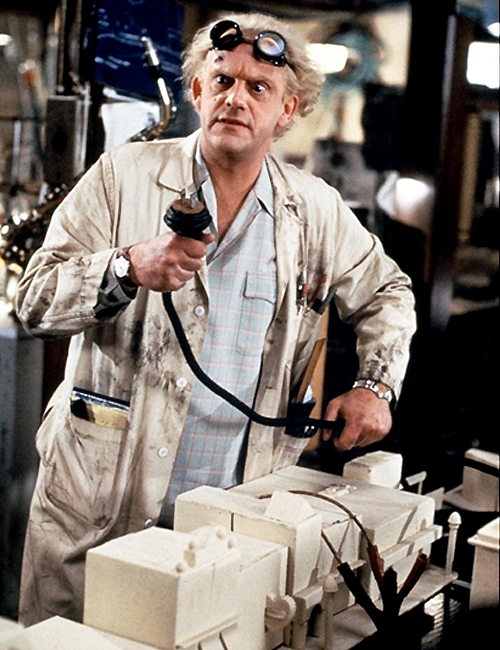
When I was younger, I used to play at being a mad scientist. My scientific endeavours ranged from George’s Marvellous Medicine style concoctions – mixing a little bit of everything I could get my hands on together in a container (though not, thankfully, feeding it to my brother) – to hiding foodstuffs in corners and watching them go mouldy (sorry Mum). It goes without saying that I also built time machines and spaceships. I suppose I was rather an interdisciplinary scientist, but then all the good ones on TV are.
So when I started secondary school and had a WHOLE CLASS dedicated to science, you may have expected me to be disappointed by the rather pedestrian experiments, after all there were no time machines. However, these experiments tended to work and have interesting results, so that I needed a lot less imagination (the use of which had become rather uncool on moving up to the big school). Iodine turns black when you drop it on potatoes! The enzymes in liver make hydrogen peroxide go all foamy!
The more advanced my scientific education got, however, the less the experiments seemed to work. Of course, any scientist reading this will note that a true experiment doesn’t work or not work, but what I mean is that these pre-prescribed experiments were supposed to be repeatable and had an expected outcome that was meant to demonstrate a principal. Sometimes nothing happened because my lab partner and I were not paying attention/melting things with Bunsen burners (a learning experience). However, sometimes this was due to antique laboratory equipment or reagents (frustrating, but also preparation for later laboratory disappointments). Whilst at school I went on two work placements in real laboratories, and was in over my head. The laboratory equipment was as far from what I knew from school as a potato is from a time machine. Whilst I had found secondary school science very entertaining, it was these work placements that really gave me a glimpse of how exciting a scientific career could be.
Early university labs got a bit more upmarket, but more often than not were disconnected to front line science. Of course, practical labs are can be very useful for illustrating textbook principals and teaching the basics of lab science and experimental design. Label your tubes! Write everything down! Don’t pick your nose! Perhaps the disconnect is less obvious in ecology (I hear they still use quadrats, though data analysis has moved on significantly) but the gap between real life molecular biology, biochemistry and especially biotechnology and those in the undergraduate practicals is often vast. This is in no way the fault of the universities. Large, safe, reproducible experiments that teach students something are very difficult to organise. Most notably, laboratory equipment is very expensive to obtain and maintain. It’s no wonder that universities don’t want 500 undergraduates wearing their safety goggles backwards and shouting “great Scott!” next to next generation sequencing apparatus. During my PhD, I gave a brief talk to early stage biology undergraduates about the methods I was employing for my research (since I didn’t actually have any results yet). Many came to me afterwards saying how exciting it was to see the application of what they were learning in classes, and I like to think that this inspired some of them. Such talks from researchers are certainly valuable to bridge the gap between undergraduate and career science, but at the end of the day are just another lecture to sit through with a hangover. What is really needed is something more interactive.

And then there was Labster – a “3D learning environment based on a virtual lab”. Not only do you get to muck about with a million dollars worth of laboratory equipment, but you get to solve cases based on real life problems. Science! Videogames! CSI! Naturally, I had to have a go (for research purposes of course). To my shame, upon picking up a sample in my virtual pipette, I was reminded that I couldn’t use the same pipette tip to pick up another sample. I also took great pleasure in causing an explosion without any life or career threatening repercussions (in retrospect, maybe not a good example to set young scientists). Certainly, it can’t help develop awesome motor skills required for superstar pipette usage (just saying), and it won’t teach you to open a falcon tube with one hand, but it can show you what you need to put in your PCR reaction (although it does remind you that you have forgotten your template BEFORE you run the PCR, go off to lunch, cast and run your gel and find out there’s nothing in your lanes).
Labster also goes one better, because whilst the PCR is running it shows you what is going on in those tiny tubes filled with clear liquid (molecular biology seems to be 90% pipetting clear liquid about) through some pretty striking animations. Many lucky people can run hundreds of PCRs with no trouble and never have to really understand (or remember) what’s going on at each step, but I can’t stress how important it is to visualise these steps when troubleshooting. To keep you on your toes, there are questions following each procedure, to make sure that you really do understand what is going on.

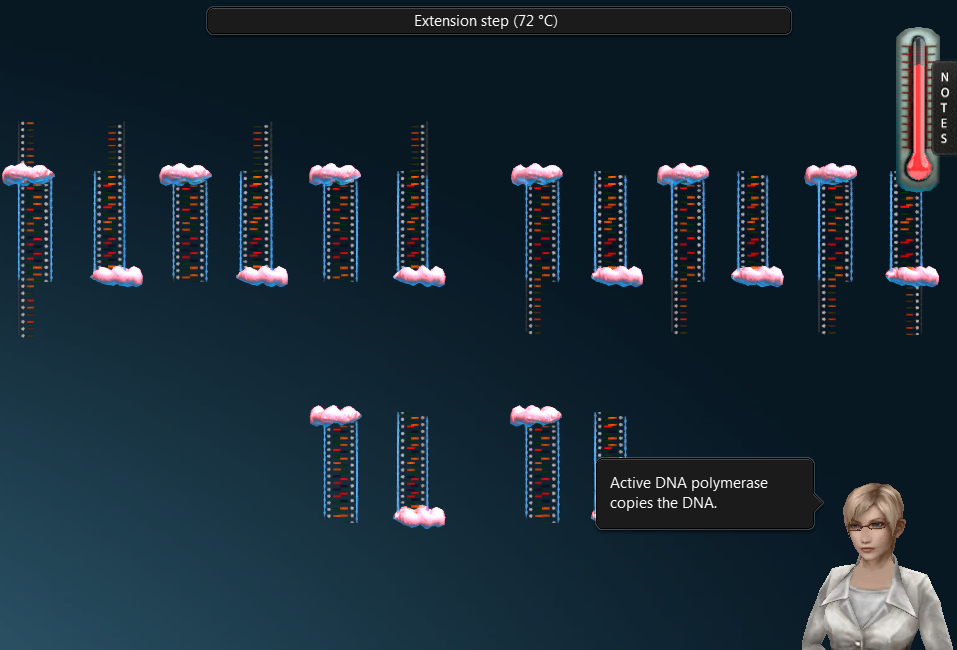
It’s not just PCR. You also have access to, for example, a fermentor and chromatography and DNA sequencing equipment. The cases you get to solve range from my favourite CSI case – a whodunnit involving blood samples – to a medical genetics cases, and are developing all the time. You don’t have to be a geek to find it really cool, though it helps.

Labster is a unique and valuable learning experience that connects classroom theory with the biotech industry, and could help to make scientists of the kids that are currently hoping their mum won’t find the mouldy Philadelphia behind the radiator.


